When the Grid Can’t Keep Up: Powering the AI Era
Posted on July 08, 2026
The AI boom is driving global energy demand to unprecedented levels. Find out why grid capacity is increasingly becoming a bottleneck and how mtu solutions are helping pave the way for a digital future.
The AI boom is accelerating fast – and running straight into a global power shortage. What starts as a simple prompt triggers an enormous amount of energy consumption behind the scenes. At the Datacenter Live Summit in London, Vittorio Pierangeli, Senior Vice President PowerGen at Rolls-Royce Power Systems, made this connection clear—highlighting why energy is becoming the defining factor of the AI era.
A look back illustrates the scale of change: In 2018, the first AI-generated portrait “Edmond de Belamy” made headlines—trained on just 5 to 7 gigabytes of data and selling at Christie’s auction for $432,500.
Fast forward to today, where around 43 million AI-generated images are created every day, and modern models are trained on billions of data points. That’s up to 100,000x more computational resource consumption than that early experiment. And this is just one small example of AI use in daily life.
We have entered a new era of power demand. AI is no longer a niche application — it has become a global driver of electricity consumption.
Why power availability is becoming the bottleneck
Artificial intelligence depends on reliable power - and a lot of it.
Consider the difference between an AI-enabled search and a traditional Google search. Depending on the complexity of the prompt, a single ChatGPT query requires 10 to 100 times more energy than a standard Google search. When putting that into the context of computing power at a data center, AI racks today consume 100 to 120kW of power, compared to around 10kW just five years ago.
This increased demand coupled with a changing energy mix and geopolitical instability only compounds the challenges in providing reliable power. In his presentation, Pierangeli described it plainly.
“Conventional coal plants are being decommissioned, while renewable generation remains intermittent,” says Pierangeli. “In addition, geopolitical instability is increasing pressure on energy security, and the load profiles of AI data centers are growing dramatically more volatile.
”It is projected that the total power generation market will nearly triple between 2025 and 2030, driven primarily by data center demand, with the backup power segment growing at approximately 22% annually and the continuous power segment growing at 24%. Yet supply is struggling to keep pace.
“Cumulative U.S. grid power supply to data centers is forecast to fall more than 50 gigawatts short of demand by 2030,” says Pierangeli. “And while a data center itself can be built in 18 to 24 months, securing a grid connection takes 3 to 7 years.”
Speed-to-market is the name of the game when it comes to the AI-race and keeping up with demand. Major hyperscalers can’t wait several years for a utility connection, which is where new opportunities are emerging, especially for our mtu gas gensets in the near term and Small Modular Reactors (SMRs), further down the line. While hyperscalers ramped up data center capital expenditure announcements by more than 50% in early 2026 alone, the utility sector is years behind.
Prime power: Bring your own
As grid constraints intensify and public push back on data center electricity consumption slow permitting of new projects, on-site power generation becomes a key enabler. Often referred to as “Bring Your Own Power” initiatives, developers are increasingly incorporating independent power plants in new data center concepts that allow them to produce the energy needed to run the facility until grid supply or new energy sources, such as nuclear, are available.
mtu gas generator systems are an excellent fit for this continuous power supply—either directly at the data center (“behind the meter”) or as part of dedicated power plants.
With short deployment times, high operational flexibility and a modular design, these systems offer high efficiency and speed-to-market that make them highly attractive for new data center projects. In places like the U.S. where natural gas is plentiful and pipelines are well established; the operational and cost implications are also very attractive.
Smoothing out the peaks of load volatility
Perhaps the most critical challenge of the AI era is the extreme fluctuation of power demand. AI training workloads create a power management challenge unlike anything in traditional data centers. GPUs operate synchronously, generating sharp, regular power swings. Research shows that within a single 50 MW block of an AI data center, real power can swing by ±20 MW within seconds. These fluctuations can strain transformers and can disrupt the broader grid.
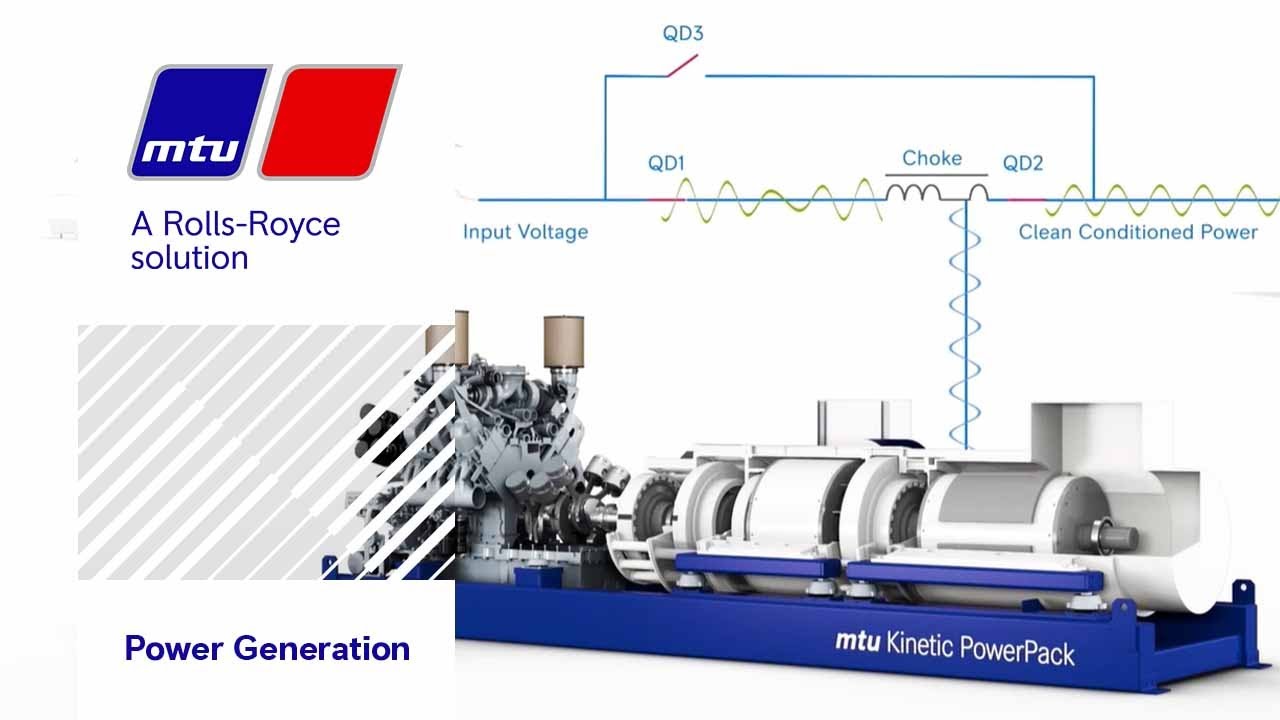
This is where mtu Kinetic PowerPacks come into play. These kinetic energy storage systems act as fast-reacting buffers within the energy system, stabilizing voltage and frequency and smoothing out power peaks. They respond instantly to load changes and provide uninterruptible power supply (UPS) functionality without the need for additional batteries.
The essential backup plan
Even with prime power secured, either in a BYOP scheme or via the grid, data centers still need a failsafe backup plan. To achieve the Uptime Institute’s Tier IV certification, modern data centers must achieve 99.99% availability, which is what our mission critical diesel backup systems ensure. Well before the current data center boom began, our hyperscale customers relied on our proven systems for their mission critical backup power. In fact, more than 25% of the data centers globally are backed up by our Series 4000 gensets.
Built for What's Next
Data centers are increasingly described as the invisible backbone of modern life – the factories of the digital age, where intelligence is produced and delivered. Powering them reliably and at the necessary pace requires solutions that can move as fast as the industry itself. Modular, scalable and fuel-flexible, our mtu portfolio meets data center operators where they are today – and where they need to be tomorrow.
Related Content

Connect with Us